

Member dues billing software for private clubs
Club Steward bills member dues on autopay by card or bank account, prorates the first period, steps promotional dues up on a set date, retries declined payments without ever charging twice, and posts every charge to a general ledger each club keeps for itself.
Dues that bill themselves, from the day a member joins.
Dues run on autopay by card or US bank account (ACH). The first period is prorated, so a member who joins mid-month pays for the days they get, and promotional dues step up on a set date without anyone remembering to change the plan. Autopay is set up inside the six-step online join (plan, household, dues & add-ons, sign, autopay, pay), and nobody pays before they sign.
- Card and bank (ACH) payments
- Statements with finance charges and food & beverage minimums
- Declined payments retried on a schedule, with card-expiry warnings
- Split-payment refunds and refunds on cancellation
- Card fee set per card brand
The club’s dues run bills each period on the club’s draft day, plan changes and cancellations are handled in-house, and the card processor only charges the card on file, so no membership depends on a processor’s subscription system. Switching card processors never touches a single member’s billing schedule.
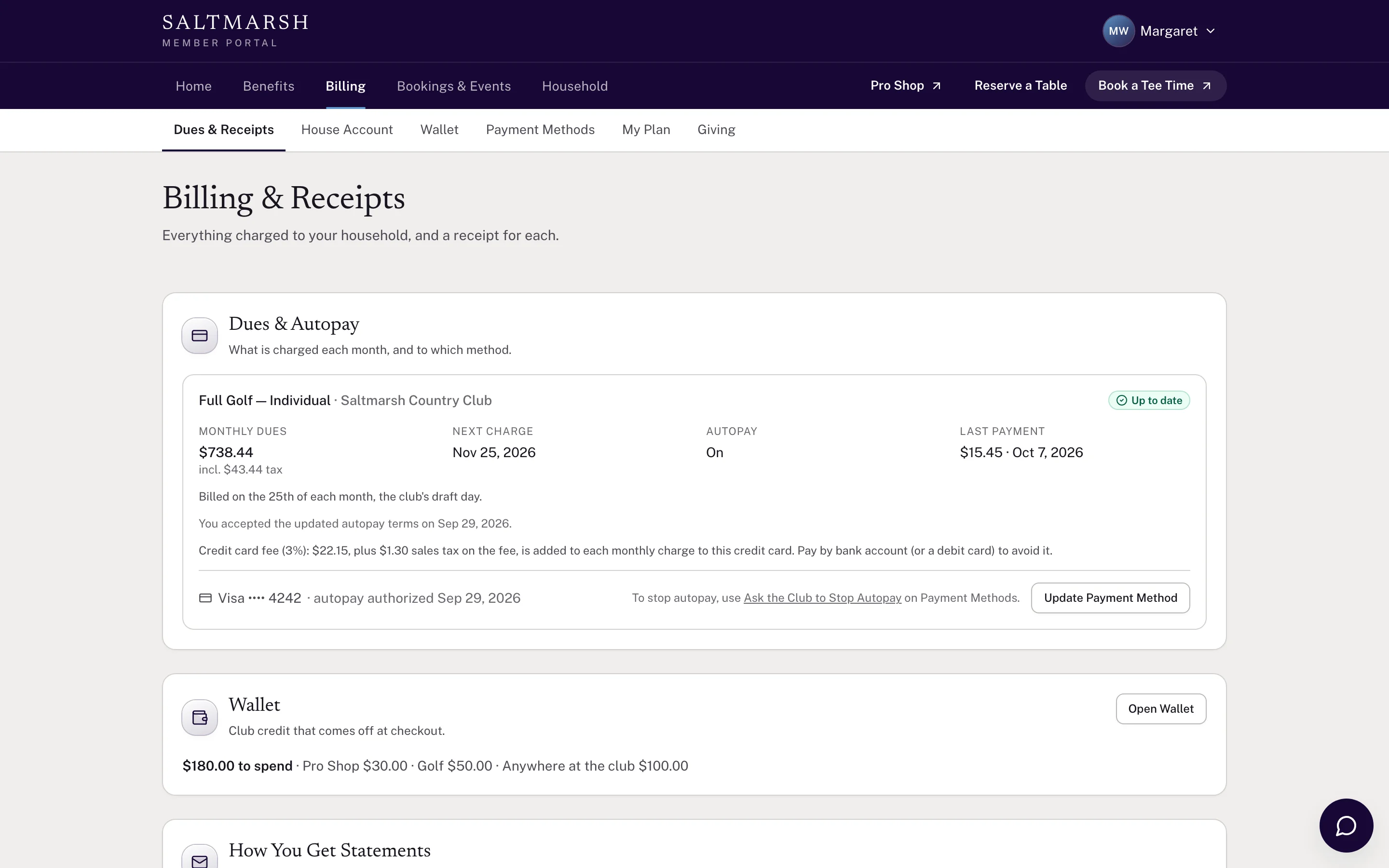
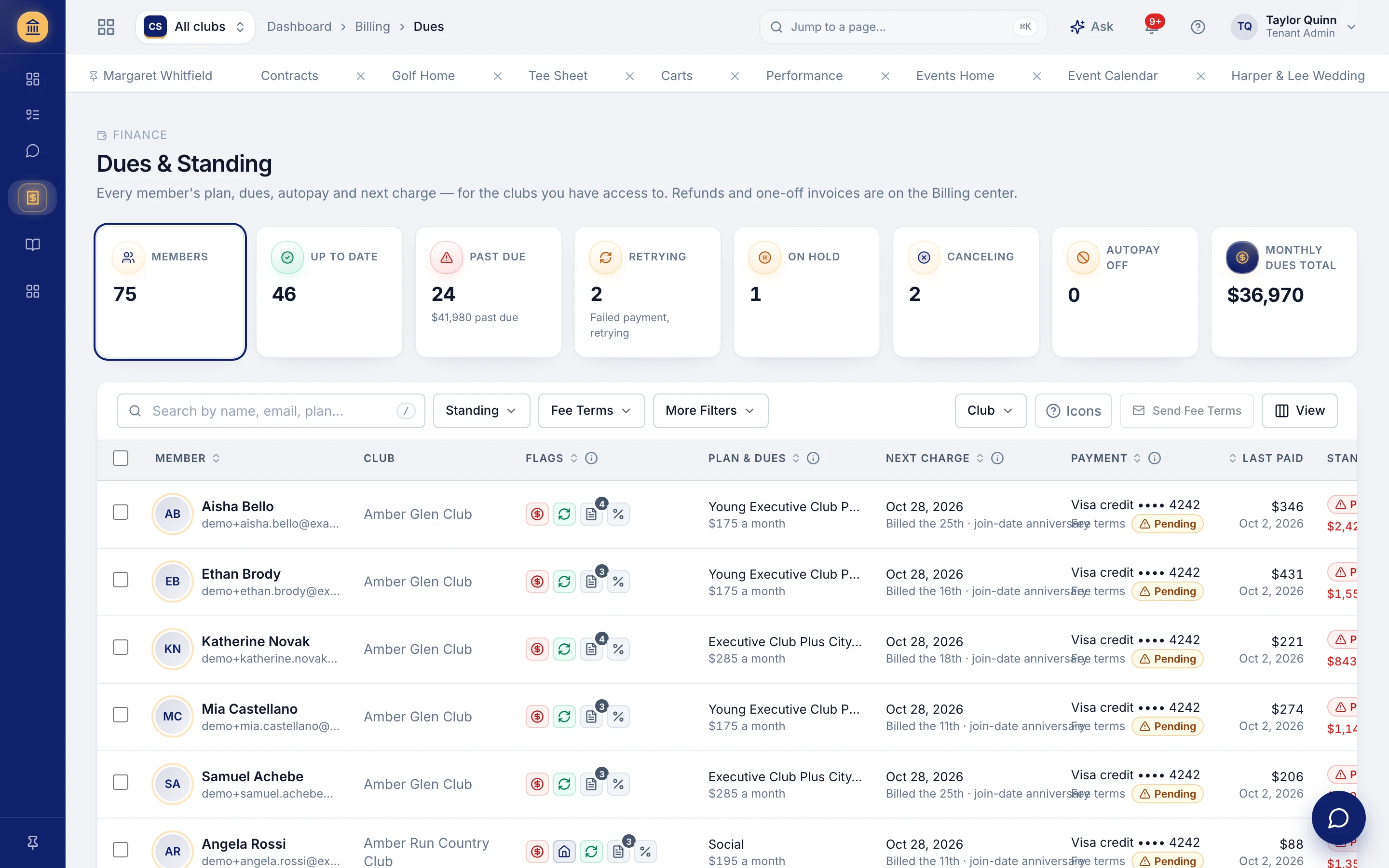
Retries at 3, 5 and 7 days. Never charged twice.
Failed payments are retried automatically at 3, 5 and 7 days, never charging twice, and members get card-expiry warnings before a card lapses. Charging is paused when an account falls behind, and when the retries run out the GM or the Membership Director gets a next step and a phone alert, so a failed draft never goes quiet.
- Dues & standing view: past due, retrying, autopay off, fee terms pending and next charge, across the membership
- Turning autopay off needs a reason, and collecting a payment is its own permission
- Split-payment refunds and refunds on cancellation
- Retention list of members likely to cancel, from the Membership Sales core
A compliant, credit-only card fee, if you choose to pass one on.
If you pass on a credit-card fee, it applies to credit cards only, is disclosed on its own line before payment, requires explicit consent, and follows state-by-state rules with the statute cited. The fee is set per card brand, so the club recovers what each card actually costs; debit never pays it; returns and refunds give back its share; and the same rule applies on every till, screen and bill, so the club never quietly absorbs card costs.
One statement for dues, dining, the shop and the tee desk.
Statements carry finance charges and food & beverage minimums. Every outlet (shop, dining, tee desk) has its own register that charges to the member’s account, and every sale lands on the member’s statement the moment it’s made. The host stand tracks each member’s dining minimum as they spend, and statement runs produce PDF and print files.
- Members see dues, next charge, autopay status and the signed agreement in their own club-branded account
- Pay Now, autopay and online statements, with push alerts when a statement is ready
- Hold, cancel or change plan from the portal, and billing follows automatically
- Plan changes signed as amendments, with the fee difference worked out
- Club wallet credit that pays anywhere in the club, and gift cards
- An AI assistant that answers first with the member’s own dues, bookings and balance, then hands off to a person
A general ledger fed by the club, not re-keyed from it.
Dues billing, tee-time fees, pro-shop sales, events and payroll post with their account, department, revenue centre and club already attached, per club or consolidated across all of them. Each club keeps its own books, fed by its own transactions, with financial statements per club or consolidated.
- General ledger, payables and receivables, per club or consolidated
- Bank reconciliation with payout matching
- Budgets, period close and financial statements
- Purchasing with approval limits and three-way match
- 13-week cash forecast, debt, leases and the fixed-asset register
- Every club’s card processor known to the books: deposits entered as settlements with their fees, each club reconciled against its own processor and its bank
- Every cent has a department, so each manager owns their numbers
- Prepaid tee-time and event deposits held as a liability until used
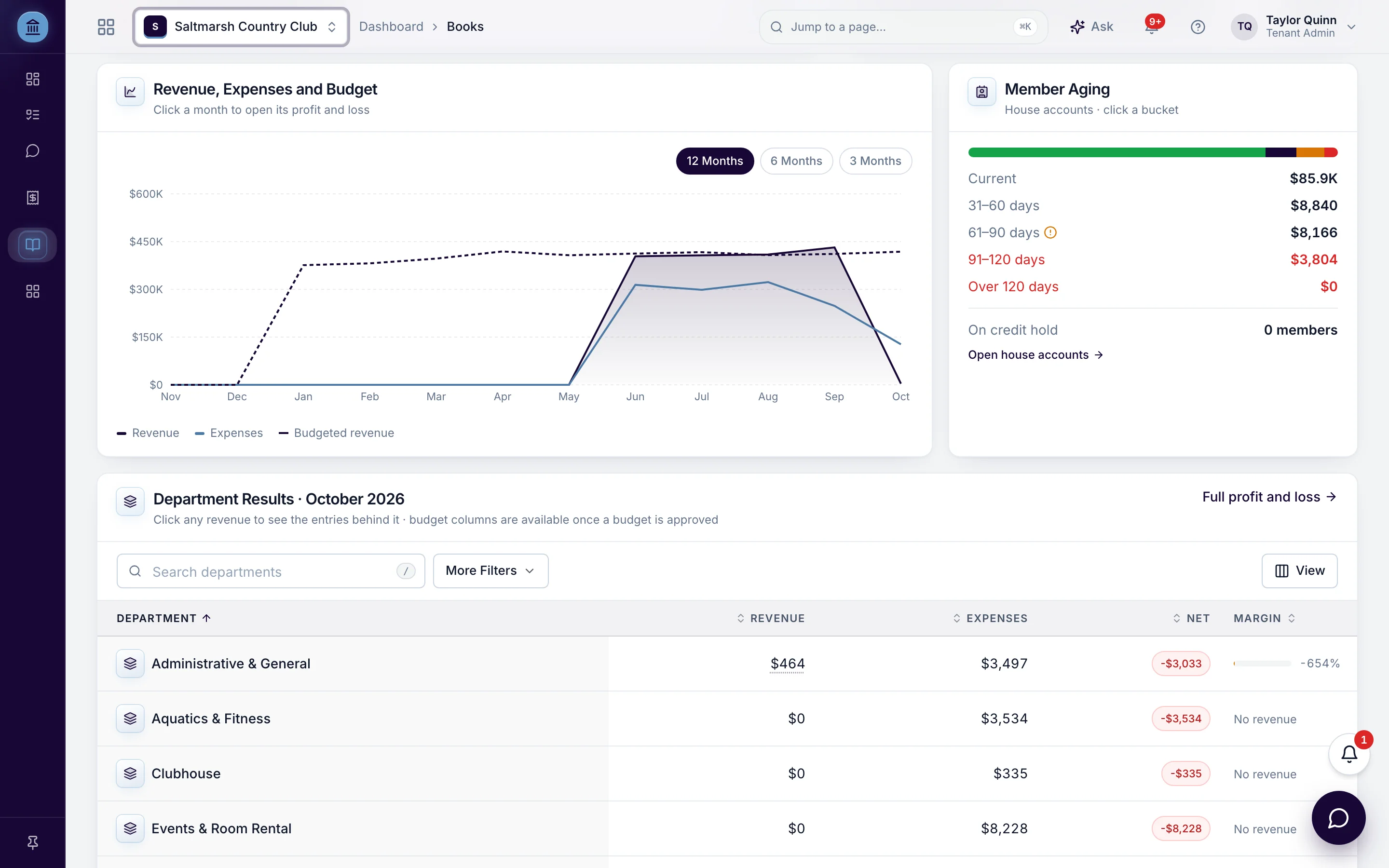
Accounting and financial reporting in detail · Books per club or consolidated across a portfolio
Twelve questions to put to any dues system, and how Club Steward answers them.
Use these with every vendor you evaluate. Each answer below is what Club Steward does today, as described on this site’s feature pages.
- 1
Does autopay take both cards and bank accounts?
Dues run on autopay by card or US bank account (ACH).
- 2
Is the first period prorated, so a mid-month join is billed for the days used?
Yes: a prorated first period and promotions are part of the six-step online join.
- 3
Can promotional dues step up to the full rate on a set date without staff remembering?
Promotional dues step up on a set date.
- 4
What happens when a card declines?
Automatic retries at 3, 5 and 7 days, never charging twice. When retries run out, the GM or Membership Director gets a next step and a phone alert.
- 5
Are members warned before a card expires?
Declined payments are retried on a schedule, with card-expiry warnings.
- 6
Do statements carry finance charges and food & beverage minimums?
Statements include finance charges and food & beverage minimums; the host stand tracks each member's dining minimum as they spend.
- 7
If we pass on a credit-card fee, is it compliant?
It applies to credit cards only, is disclosed on its own line before payment, requires explicit consent, and follows state-by-state rules with the statute cited.
- 8
Can members see and pay their bill without calling the club?
Dues, next charge, autopay status and the signed agreement are in the member's own club-branded account, with Pay Now and online statements.
- 9
Does a plan change, hold or cancellation re-bill automatically?
Hold, cancel or change plan, and billing follows automatically; plan changes are signed as amendments with the fee difference worked out.
- 10
Does the dues run post to a real general ledger, or export to one?
Every charge already carries its general-ledger account, department, revenue centre and club, so the ledger is fed by the club rather than re-keyed from it.
- 11
Can finance reconcile what the processor deposited against what members paid?
Bank reconciliation with payout matching; each club is reconciled against its own processor and its bank.
- 12
Who can turn autopay off or take a payment by hand?
Turning autopay off needs a reason, and collecting a payment is its own permission.
Want to see the dues run on a sample club? We’ll walk through join, autopay, a failed payment, the statement and the ledger in 30 minutes.
What controllers and membership directors ask first
How are member dues and payments handled in Club Steward?
What happens when a member's dues payment fails?
Can we pass a credit-card fee on to members?
What do member statements include?
Does the billing include accounting, or do we export to another package?
What can members do about their bill themselves?
See dues billing on a live club
Tell us how you bill dues today and what breaks most often. We reply within 4 business hours to set up your walkthrough.
Dues, statements and the ledger. One record.
See a membership go from a signed agreement to autopay, a statement and the club’s own books without a single number re-keyed.
Related: Club Steward overview · All Club Steward features · Golf club management software for multi-course operators · Buyer’s guide: club software for multi-club operators · Why country club software pricing is hard to compare