
Club Steward · Golf & country club management software

Country club accounting software, fed by the club itself

A full general ledger, payables and receivables, bank reconciliation, budgets, period close and financial statements for golf and country clubs. Every charge already carries its general-ledger account, department, revenue centre and club, and each club keeps its own books, per club or consolidated.

Every charge arrives coded

A general ledger fed by the club, not re-keyed from it.

Every charge in Club Steward already carries its general-ledger account, department, revenue centre and club when it is made. Dues billing, tee-time fees, pro-shop sales, events and payroll post to each club’s own books automatically, so there is no nightly export to an accounting package and nothing to re-key at month end.
  • Each income, cost and expense line names its department, or waits on a short list for the controller
  • No floating charge: every dollar on the P&L sits with a department, so each manager owns their numbers
  • A deleted or recycled record takes its postings back, and a restore posts them again
  • Ledger and member data sent to the club’s reporting warehouse on a schedule, with retries
Accounting · Books
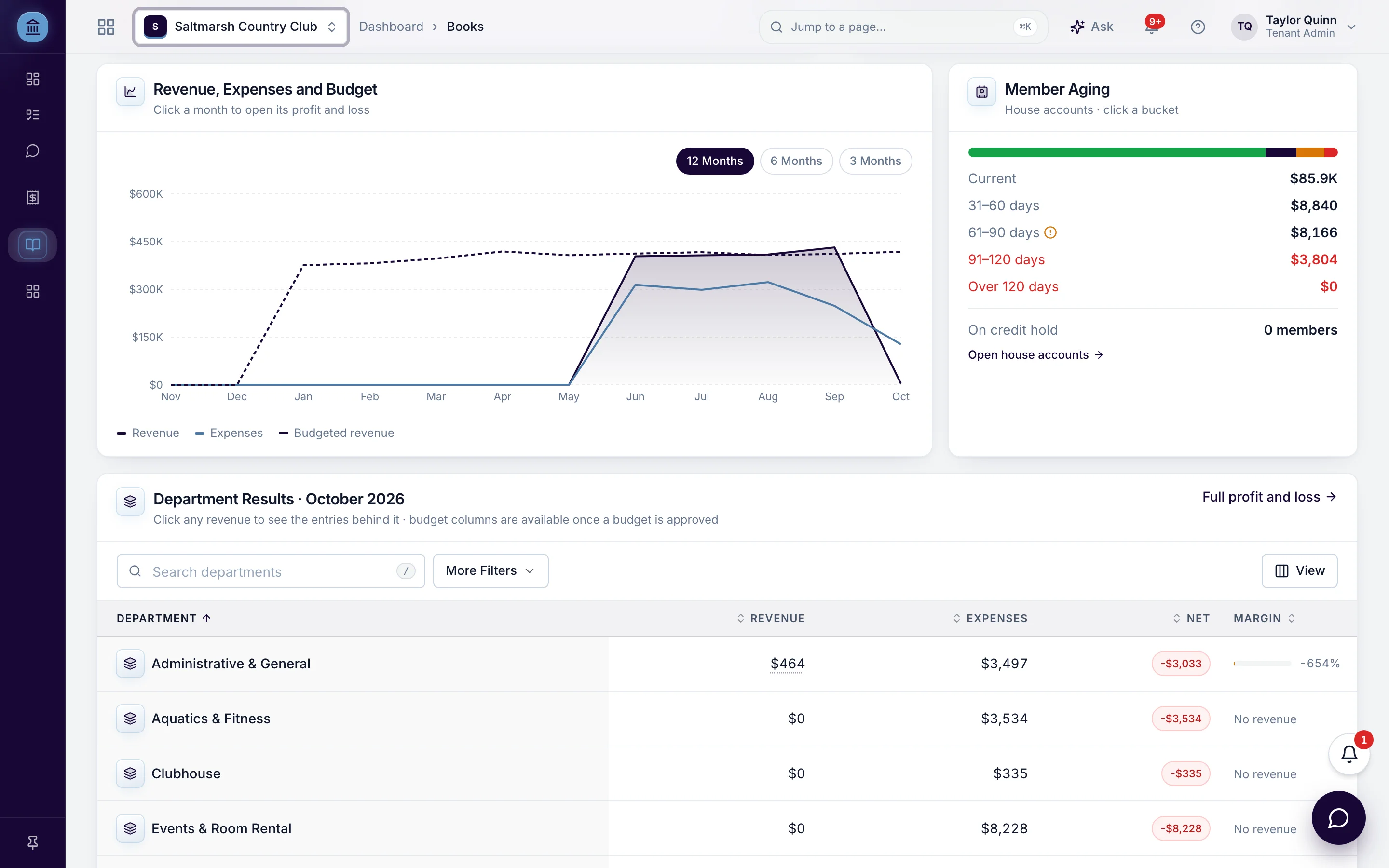
One club's books: a 12-month revenue, expense and budget chart, member account aging, and results by department
Golf course accounting software

Everything the course and the clubhouse sell, already in the books.

The same platform runs the tee sheet, the registers, dues and events, so each posting starts where the money is made.

Dues and member billing

Each dues run posts to the club's own books with its account, department, revenue centre and club attached.

Tee-time fees and the golf shop

Tee-time fees and pro-shop sales post the moment they are made, and stock is kept as a ledger with cost by FIFO or LIFO and profit by item.

Dining and every other outlet

Every register charges to the member's account, and drawer pay-outs post to their own accounts.

Events and deposits

Event revenue posts with its department, and prepaid tee-time and event deposits are held as a liability until used.

Payroll

Every payroll dollar is posted to the books, with the payroll provider's file each period.

Fixed assets, including the cart fleet

Carts, mowers and kitchen equipment sit on one asset register that depreciates into the club's own books.

Country club AP software

Payables with approval limits and three-way match.

Accounts payable runs per club or consolidated. Purchasing works with approval limits and purchase orders, and three-way match checks each purchase order against the receipt and the invoice before anything is paid. Every cost and expense line names its department, or waits on a short list for the controller, so nothing reaches the P&L without an owner.

  • Purchase orders matched against receipts and invoices before payment
  • Approval limits on purchasing
  • A new vendor is asked for their W-9 and insurance in one step
  • With the optional Active AI, a photo of a receipt becomes an expense
  • Payables and receivables per club, or consolidated across the portfolio
Per club or consolidated

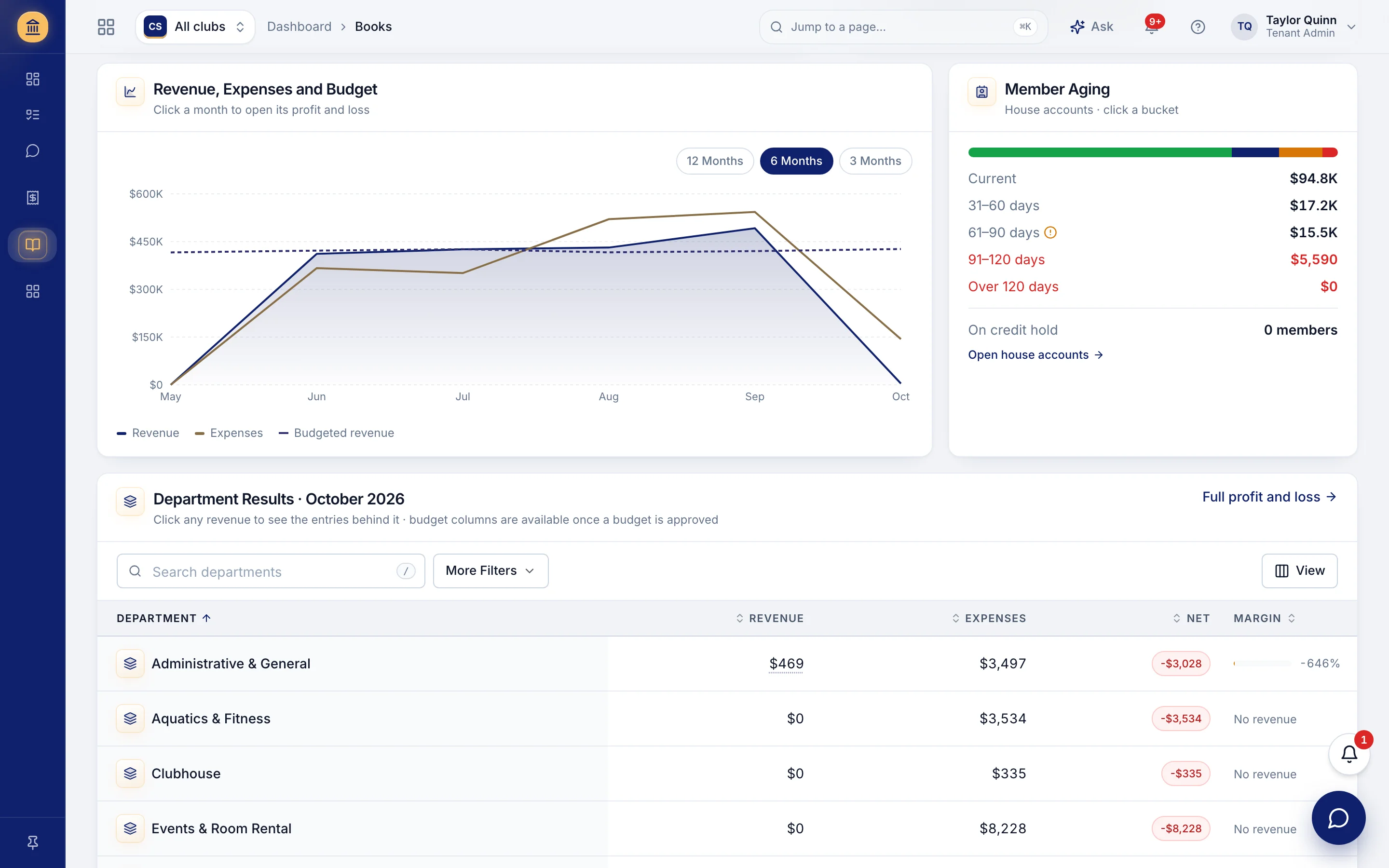
Each club keeps its own books. Corporate sees them together.

Each club keeps its own books, fed by its own transactions, with financial statements per club or consolidated across all of them. Corporate finance gets loans, leases and inter-club accounting in the same books as the clubs, and club-level data isolation is enforced in the database.
Screens show sample figures.

Bank reconciliation, budgets and period close

What the processor deposited is what members paid, less fees.

Bank reconciliation includes payout matching. Every club’s card processor is known to the books: its deposits are entered as settlements with their fees, every payment names the processor that took it, and each club is reconciled against its own processor and its bank.
  • General ledger, payables and receivables, per club or consolidated
  • Bank reconciliation with payout matching
  • Budgets, period close and financial statements
  • Purchasing with approval limits and three-way match
  • 13-week cash forecast, debt, leases and the fixed-asset register
  • Prepaid tee-time and event deposits held as a liability until used
  • The fixed-asset register, including the cart fleet, depreciates into each club’s own books
Accounting · Balance sheet
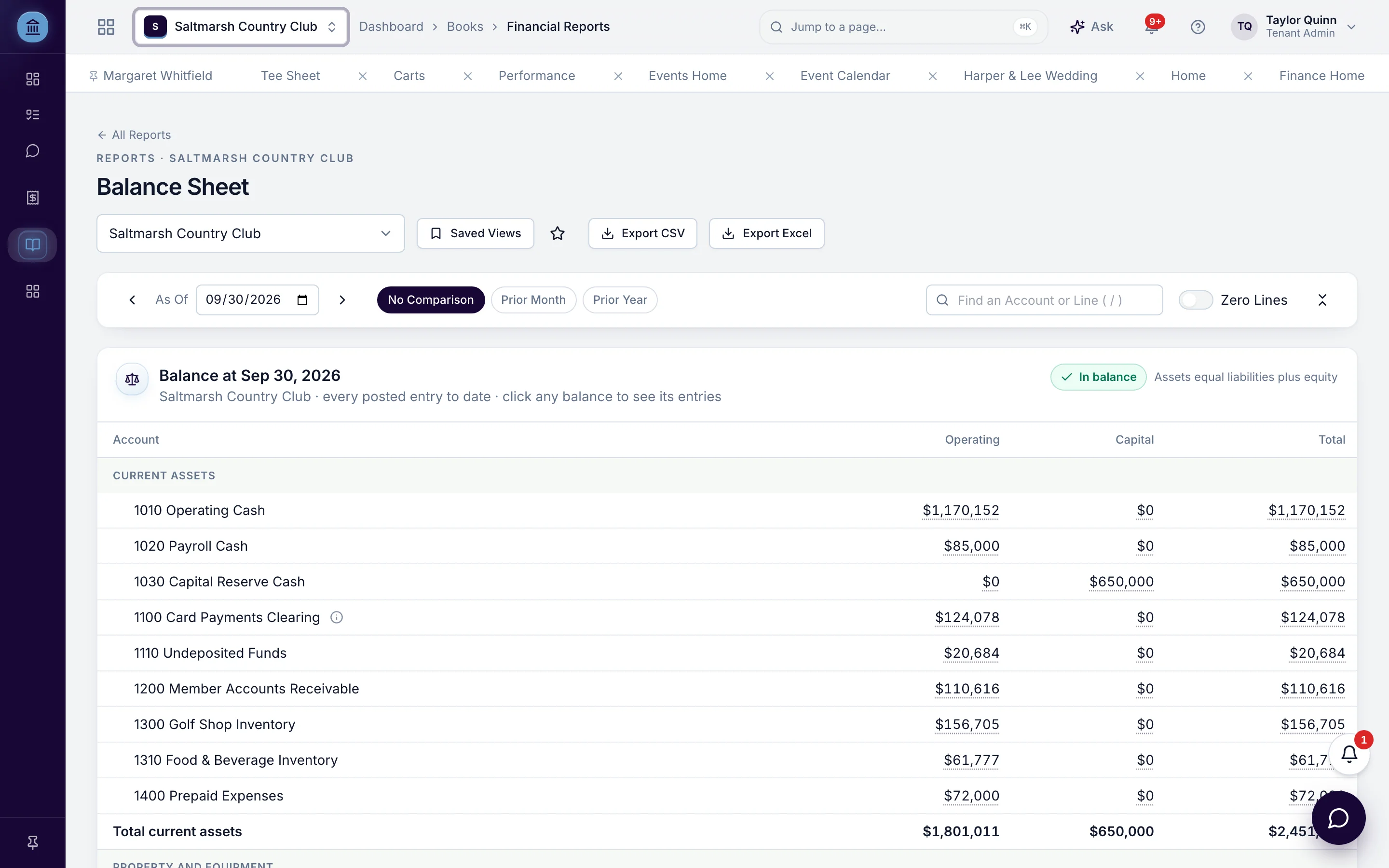
A balance sheet as of September 30 with operating and capital columns and an in-balance check

Member dues billing software for private clubs · Accounting and financial reporting in detail · Books per club or consolidated across a portfolio

Want to see the books on a sample club? We’ll follow a dues run, a pro-shop sale and an event deposit into the general ledger in 30 minutes.

Questions

Country club accounting: what controllers ask first

What is country club accounting software?
Country club accounting software keeps a club's books: the general ledger, accounts receivable and payable, bank reconciliation, budgets, period close and financial statements. In Club Steward the accounting suite sits on the same member record as dues, the tee sheet, point of sale and events, so a charge at the bar, a tee time and a dues payment land on the same statement and the same general ledger without anyone re-keying them.
How do charges reach the general ledger?
Every charge in Club Steward already carries its general-ledger account, department, revenue centre and club, so the ledger is fed by the club rather than re-keyed from it. Dues billing, tee-time fees, pro-shop sales, events and payroll post that way. Each income, cost and expense line names its department or waits on a short list for the controller, and a deleted record takes its postings back, while a restore posts them again.
Does Club Steward include accounts payable?
Yes. Payables and receivables run per club or consolidated. Purchasing works with approval limits and purchase orders, and three-way match checks each purchase order against the receipt and the invoice before anything is paid. Every cost and expense line names its department, and with the optional Active AI a photo of a receipt becomes an expense.
Can each club keep its own books and still report consolidated?
Yes. Each club keeps its own books, fed by its own transactions, with financial statements per club or consolidated across all of them. Corporate finance gets loans, leases and inter-club accounting in the same books as the clubs, and club-level data isolation is enforced in the database, so one club's staff cannot query another club's records.
How does bank reconciliation work with card deposits?
Bank reconciliation includes payout matching. Every club's card processor is known to the books: its deposits are entered as settlements with their fees, every payment names the processor that took it, and each club is reconciled against its own processor and its bank, so the controller sees that what was deposited is what members paid, less fees.
What financial statements and forecasts are included?
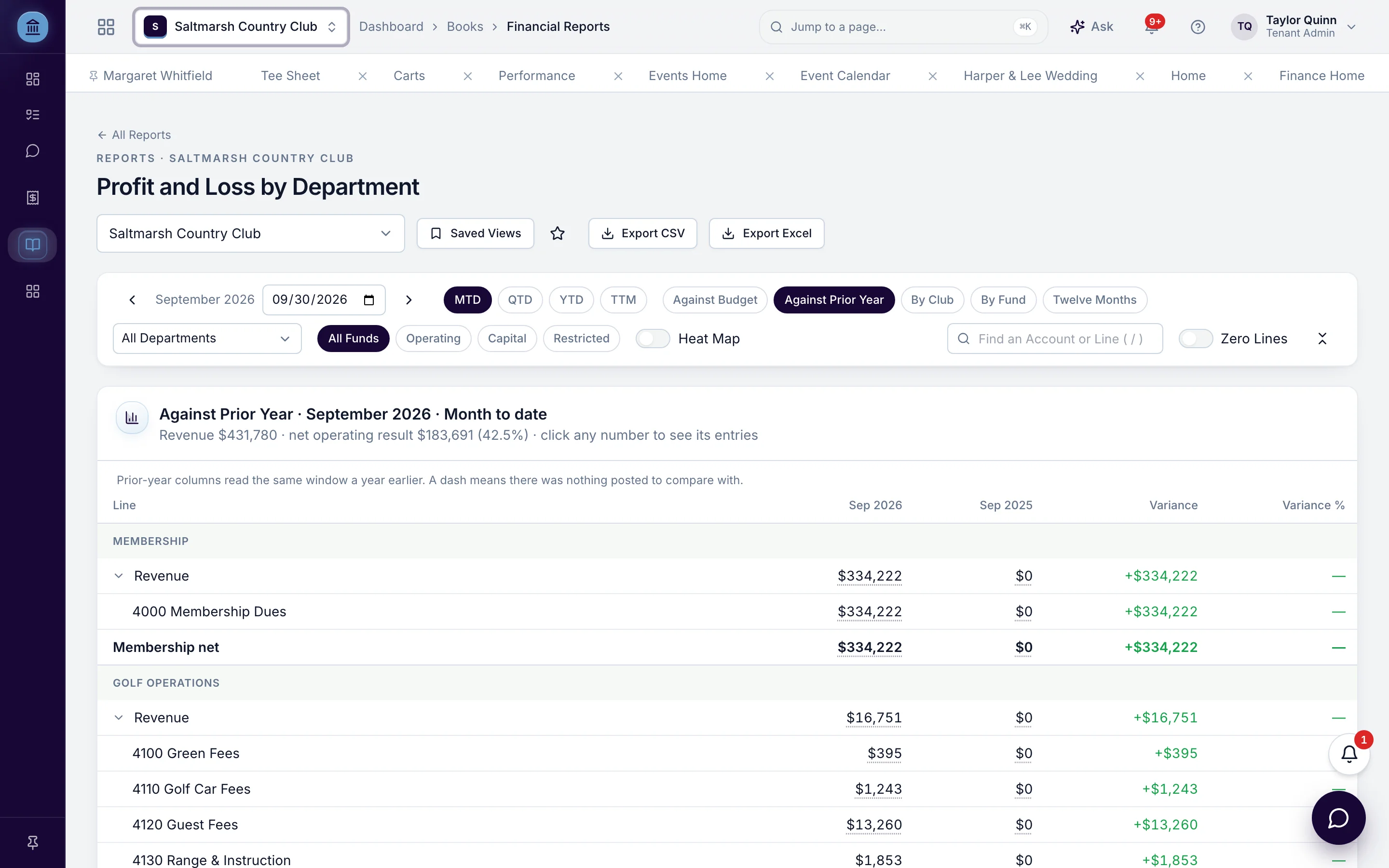
Profit and loss by department against budget and prior year, the balance sheet and cash flow, with PDF and CSV export, per club or for all clubs. Budgets and period close are built in, along with a 13-week cash forecast, debt, leases and the fixed-asset register.
Free & no obligation

See club accounting on a live club

Tell us how your clubs keep their books today and what slows the month-end close. We reply within 4 business hours to set up your walkthrough.

We reply within 4 business hours · No obligation

We'll only use this to reply about your project. No spam, ever.

Every charge, already in the books. Every club.

See a dues run, a tee time and an event land in each club’s general ledger with their account, department and club attached, then roll up for corporate.